Adapted from Boxer, P.J. 2021. “Working Beyond The Pale: when doesn’t it become an insurgency?” In ISPSO Annual Conference. Berlin.
Three moments and three crises in the Leadership Discourses
The three moments, each with its associated crisis, describe a cycle in the way an individual takes up an identification. This cycle of identifications, socially-mediated relations to lack, moves through
- an imaginary identification with a way of feeling,
- a symbolic identification with a way of thinking, and
- an identification with a situated way of being in relation to lack, i.e., in a relation to the value deficit in a situation.
The crises arise when an identification falls short of what the individual was hoping for, experienced as a value deficit. For the first two crises, the value deficit experienced is about the individual’s way of being, while the value deficit for the third is in the situation per se. The crises corresponding to each identification can be summarized as:
- a frustration that there is more involved than identifying with a way of feeling,
- a privation that, while identifying this way of thinking may work for others, it’s not working for the individual, and
- there remains something lacking in the situation that demands more than what current identifications have to offer[1]. Yet more is needed.
It is this third crisis that demands that the individual goes beyond what s/he knows in order to form a new way of being in relation to the situation. The demand is to take an innovative or creative leap that lets go of present ways of identifying and starts a new cycle.
Moving through these crises depends on the way an individual holds his or her anxiety. In the first frustration crisis this means dealing with performance anxiety, while in the second privation crisis it means dealing with existential anxiety, a seemingly unsurmountable difficulty.[2] This third crisis feels like ‘living between two deaths’. While the first of these two deaths is the symbolic death involved in getting beyond the second crisis, a death that feels like ‘paying with being’, the second death is being dead for real.[3] An identification with each leadership discourse comes up against this third yet-more-is-needed crisis in a different way:[4]
- 1. In cultivating relational agility (the leadership discourse of the Hysteric), it is encountering an inconsistency that cannot be resolved.
- 2. In providing dynamic containment (the leadership discourse of the Master), it is coming up against an incompleteness in the container per se.
- 3. In providing holding through the doubling of the double task (the leadership discourse of the University), it is the indemonstrability that such boundary-holding is effective.
- 4. In attuning to and addressing the value deficits of ‘others’ (the leadership discourse of the Analyst), it is facing an undecidability in how to be in relation to the value deficits of the ‘other’.
The cycle in the way an individual takes up an identification with a discourse thus applies to each one, its generative characteristics coming from the way the individual works through the first two crises. Each quarter-turn around the cycle of generative discourses involves taking up the challenge presented by the impossibility in the previous discourse. Whether or not a circulation of discourses becomes possible thus depends on how each discourse is identified with and on how the perverse discourses and their supporting Lines of Development (LoDs) mediate the relations between those identifications.[5]
The relationship to the perverse discourses
The systemic nature of the LEoD comes from the way the leadership discourses are supported by their perverse forms. Individuals identify with these perverse discourses when they set aside the generative effects of their individual relation to lack to follow the way their role has been defined within an operative organization.
This mediating relationship is important in determining what progression is possible in the competitive behaviors of an operative organization (the progression through r-type, c-type and K-closed to K-open forms of competitive behavior). Resistance to this progression, a resistance based on conserving existing ways of having identifications supported by the LoDs, can lead to maladaptation.[6] It further describes how, in the case of K-open forms of competitive behavior, maladaptation arises from there being resistance to a circulation of discourses itself. This resistance is to changes in how the domain of relevance itself is defined, changes that demand an ecosystemic understanding of operative organization.
In understanding what determines maladaptation, the Chapter looks first at the individual roles identified with the perverse discourses, identifications in which individuals adopt a Faustian relation to the role, pursuing it instrumentally as an end in itself. The perverse discourses have a maladaptive effect to the extent that they suppress crises emerging in the way the generative discourses are identified with (the italics in the diagram below):
- 1. suppressing questioning of capabilities that would put the operative domain of relevance into question[7],
- 2. clinging to illusions of stability created by current structures,[8]
- 3. becoming trapped in an organization’s own success stories created by its current narrative framing,[9] or
- 4. turning a blind eye to the singular nature of the customer’s context-of-use, dismissing and excluding the value deficit being experienced by the customer[10].
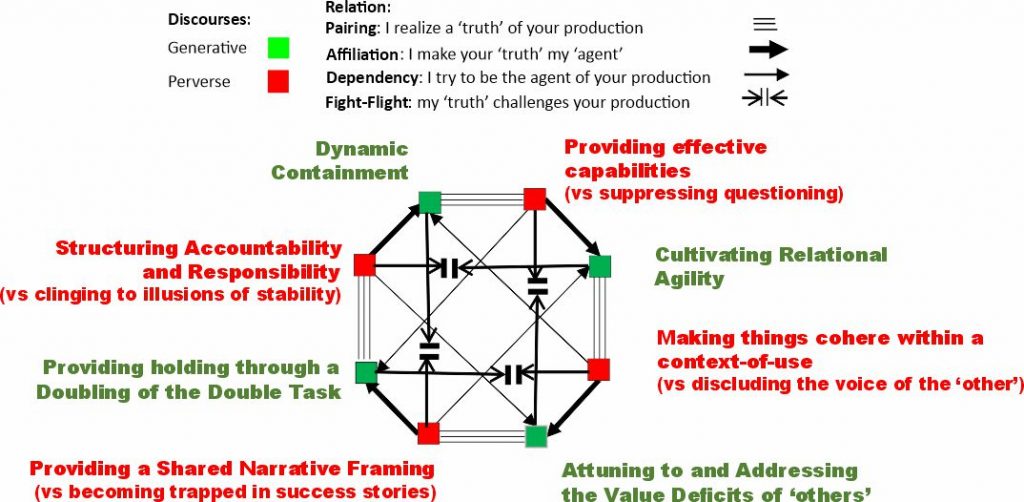
One then looks at the affiliative relationship that each perverse discourse has to its generative form, described by Turquet’s One-ness (Turquet 1974). A leadership discourse held solely on the basis of the first imaginary identification gives that leadership discourse the characteristics of the fifth basic assumption Me-ness (Lawrence, Bain, and Gould 1996). This imaginary identification places a limit on the nature of the affiliation to it by those identified with its perverse form.[11] When any one of the other three leadership discourses are held on the basis of an imaginary identification, the relationship to it of a perverse discourse is limited to the basic assumption characteristics of dependency, pairing or fight-flight (Bion 1959): [12]
- Pairing: I realize a ‘truth’ of your production
- Dependency: I try to be the agent of your production
- Fight-Flight: my ‘truth’ challenges your production
These Pairing and Dependency relations conserve existing identifications across the LEoD by locking in the way the generative discourses are presently being supported, while the Fight-Flight relations resist changes in identifications across the LEoD.
As any one leadership discourse develops past its first crisis, other leadership discourses may still be in an imaginary identification. The perverse discourses relating to them may thus still resist changes by conserving their existing affiliations and/or Faustian relations to their roles. The LEoD provides a diagnostic tool, therefore, for examining in what way it may be ‘stuck’ in an existing above-the-strategy-ceiling relation to the operative organization through analyzing possible sources of resistance.
To the extent that identifications change and resistance lessens, so the relations within the LEoD move from unconscious basic assumption dynamics towards workgroup assumptions (French and Simpson 2010). As long as pre-existing identifications persist, however, the LEoD will exert resistance from above the strategy ceiling to any changes in the LoDs below the strategy ceiling.
The consequences for managing adaptation
The strategy ceiling of a corporation is lifted to enable it to engage in a progression of increasingly complex competitive behaviors. The working-through of each crisis in identification, together with complementary changes in how the perverse discourses are identified with, enables a progressive adaptation of the LoDs to each new kind of demand for value creation. For this to lead to a full circulation of discourses, all of its leadership discourses will need to have worked through all three crises. The operative organization supporting the LEoD will also have become a structural ecosystem that contains all four forms of value-creating behavior.
At each step along the journey to this point, the current adaptation of a corporation will need to have been identified by its leadership as problematic for its competitiveness. Overcoming this maladaptation will have involved considering:
- What are the supporting forms of operative organization?
- How is the maladaptation apparent in the current state of their relevant Lines of Development (and therefore what further development is being called for).
- What form does the LEoD currently take above the strategy ceiling and how is that reflected in the forms of resistance to making the adaptations currently being experienced.
- Which identifications need to be challenged and supported in different ways as a consequence.
In practice, where the current adaptation of a corporation has not been identified as problematic by its leadership, an analysis of its LEoD identifies its counter-resistance to adaptation. This counter-resistance conserves the existing ways in which identifications are being supported by the existing state of its Lines of Development.
EndNotes
[1] This is referred to in Lacanese as symbolic castration in Book IV (Lacan 2013[1957]).
[2] These are the two axes of anxiety that Lacan writes about in Book X (Lacan 2014[2004]).
[3] Written about in Lacan’s Book VII (Lacan 1992 [1959–1960]).
[4] These four are in Radiophonie. Scilicet, 1970. 2(3).
[5] Different spans of complexity describe the different ways in which these primary tasks may be defined in response to the competitive dynamics of their environment:
- 1. replicating the use of given capabilities, referred to as r-type;
- 2. concrete ways of using a range of r-type capabilities to secure pre-defined outcomes defined by a vertical structure of accountabilities and responsibilities, referred to as c-type;
- 3. the systematic orchestration of a number of c-type composite capabilities using know-how to align them in pre-defined ways to a customer’s situation, referred to as K-closed; and
- 4. the comprehensive orchestration and synchronization of a number of c-type composite capabilities using know-how to make their use cohere within a customer’s context-of-use, referred to as K-open.
These are the bottom four layers of Jaques’ levels of abstraction (Jaques, Gibson, and Isaac 1978), defined as Lines of Development (LoDs). These describe what is needed to address the progressively more complex causal textures of the environment described by Emery and Trist (Emery and Trist 1965):
- 1. r-type providing effective capability (supporting the Discourse of the Hysteric),
- 2. c-type structuring accountability and responsibility (supporting the Discourse of the Master),
- 3. K-closed providing of a shared narrative framing (supporting the Discourse of the University), and
- 4. K-open bringing things together (cohesion) within the customer’s context-of-use (supporting the Discourse of the Analyst).
These LODs are cumulative in that each one depends on being supported by its prior LoDs.
[6] Of course raising the questioning of who cares, for whom does it matter etc… although ultimately, the failure to address this maladaptation leads to the systemic collapse of the ecosystem(s) of which it is a part.
[7] The Discourse of Science, the perverse form of the Discourse of the Hysteric, written about in (Lacan 2002[1996])
[8] The Discourse of Capitalism, the perverse form of the Discourse of the Master, written about in (Lacan 1978)
[9] The Discourse of Masquerade, the perverse form of the Discourse of the University, written about in (Lacan 1990[1974])
[10] The Discourse of the Movement, the perverse form of the Discourse of the Analyst,, also written about in (Lacan 1990[1974])
[11] These limitations are spoken of in terms of racism in (Lacan 2009):
- 1. Fixing on particular oral truths by privileging particular (discriminatory) narrative organizations
- 2. Fixing on a particular anal relation to surplus value by privileging the (enslaved) places in the system
- 3. Fixing on a particular way of organizing the gaze by privileging a particular framing narrative
- 4. Fixing on a particular way of following an invocatory legacy by privileging particular (fashionable) certainties
The four different kinds of partial object, depending on where (a) appears in the quadripod structure, is in (Lacan 2014[2004])
[12] In the figure, dependency is across the diagonal, pairing is the triple-line relation and fight-flight is the vertical and horizontal relations.
References
Bion, W.R. 1959. Experiences in Groups (Tavistock Publications: London).
Emery, F.E., and E.L. Trist. 1965. ‘The Causal Texture of Organizational Environments’, Human Relations, 18: 21–32.
French, R.B., and P. Simpson. 2010. ‘The ‘work group’: Redressing the balance in Bion’s Experiences in Groups‘, Human Relations, 63: 1859–78.
Jaques, E., R.O. Gibson, and D.J. Isaac (ed.)^(eds.). 1978. Levels of Abstraction in Logic and Human Action (Heinemann: London).
Lacan, J. 1978. ‘Discourse of Jacques Lacan at the University of Milan on May 12 1972.’ in, Lacan in Italy (La Salmandra: Milan).
———. 1990[1974]. Television: A Challenge to the Psychoanalytic Establishment (W.W. Norton & Company: London).
———. 1992 [1959–1960]. The Seminar of Jacques Lacan, Book VII: The Ethics of Psychoanalysis (Tavistock/Routledge: London).
———. 2002[1996]. ‘Science and Truth.’ in, Ecrits: The First Complete Edition in English (W.W. Norton & Company: New York).
———. 2009. ‘L’etourdit’, The Letter, 41: 31–80.
———. 2013[1957]. The Seminars of Jacques Lacan – Book IV La Relation d’Objet 1956-57 (Cormac Gallaher).
———. 2014[2004]. The Seminars of Jacques Lacan Book X – Anxiety 1962-1963 (polity: Cambridge, UK).
Lawrence, W.G., A. Bain, and L. Gould. 1996. ‘The Fifth Basic Assumption’, Free Associations, 6: 28–55.
Turquet, P.M. 1974. ‘Leadership: The individual and the group.’ in G.S. Gibbard, J.J. hartmann and R.D. mann (eds.), The large Group: Therapy and Dynamics (JosseyBass: London).